 |
A. muscaria growing under birches in northern Europe. Image A. Sinclair.
|
One of the
things that I have always found attractive about archaeology is the emphasis on evidence to recreate an understanding of the past. However, I
find this even better when research from fields like linguistics are combined
with archaeology to back claims up.
Therefore,
attempts to create interesting narratives about the past with the minimum of
evidence really do my head in. Evidence that at a stretch would be described as
circumstantial if it was a police investigation and a court was in a very
generous mood.
In this case however, I doubt it would even get past the
officer on the front desk, because this is about the myth of psychoactive
mushroom use in ancient Egypt, that, if you did not know, is a bit of a thing
in the fringe scene.
The idea
being that in Egypt the king or a few superdooper elite priests would consume
psychoactive mushrooms during secret rites in order to attain an altered state
and ascend to the realm of the
gods.
 |
| Psilocybe cubensis. Image LordToran at Wikipedia. |
These claims
involve two well known psychoactive mushrooms - Amanita muscaria (‘fly
agaric’) and Psilocybe cubensis (‘Cuban bare head’). The myths are
not particularly new, and blame for this may be laid at the doors of a handful of resourceful fringe authors over the past 60
years.
I will try to keep it brief and only cite the main movers (you can find
their groupies easily enough) before ending with the guy who started the ball
rolling - Andrija Puharich. This will be followed by a few examples of the
claims in contemporary culture. My aim is broad btw, I am not limiting my irritation
to the fringes, but to anyone who cites these myths.
We begin with a paper by the individual who is at least partially responsible
for my interest in this topic. Some responsibility also lies with an
Egyptologist friend, with my partner and his arcane circle of mycophiles, and
with the researchers at the Science in Ancient Egypt website who
foolishly gave me something interesting to do over the last year.
1. The
Entheomycological Origin of Egyptian Royal Crowns (2005)
Stephen Berlant is a psychologist who fancies himself a bit of an expert on psychoactive mushroom use in remote antiquity. His first publication on this topic was called ‘The Prehistoric Practice of Personifying Mushrooms’ (1999) and elaborates on the connection of magic mushrooms to prehistoric shamanism. If you are interested in studies of prehistoric psychoactives I heartily recommend you read someone more qualified, like Giorgio Samorini.
This paper was followed by the one that now serves as a foundation text for woo about magic mushies and Egypt – ‘The Entheomycological Origin of Egyptian Royal Crowns’ - in which Berlant claimed that much ancient Egyptian cult symbolism and some symbols of kingship were based on the magic mushroom -
Psilocybe cubensis (for a longer review see
here).
 |
L-R: Atef, hemhem, white, red & dual crown. Image A. Sinclair.
|
The basic
premise of this paper is that the white crown of southern Egypt was originally
based on the tiny pin (juvenile) form of the P. cubensis. But he argues that
other Egyptian crowns were symbols of magic mushrooms, like the red
crown, double crown, hemhem, atef and khepresh.
He also proposes
mushroom symbols including the Eye of Horus, the scarab beetle (scarabs roll
dung, P. cubensis grows in dung), the golden fly, Amentet (west) symbol,
snakes and the Abydos standard.
 |
L-R: Amentet standard, Eye of Horus & Abydos standard. Image A. Sinclair.
|
Highlights
would be his assertion that Egyptian kings and elites partook in secret
mystery rites involving eating P. cubensis as the Eye of Horus or as the
symbol of the white crown bestowed on them by the god Horus. Members of this
secret mystery rite were naturally called the Order of the Golden Fly.
But not limiting himself to P. cubensis, he also proposed that Osiris
was an A. muscaria, because the god looks like the mushroom, having only
one leg and being depicted in art as red and white... no really.
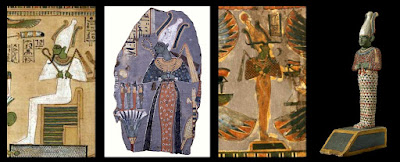 |
| Osiris showing his various forms. Images © British Museum. |
The Underworld god was the embodiment of death and regeneration,
he was represented as a mummified corpse, embalmed, not one legged.
14 years
later Berlant expanded his ideas out to two unpublished drafts that include such woo classics as claiming that the practice of celebrating Christmas with
a fir tree is descended from an ancient Egyptian ritual of decorating a fir
tree with A. muscaria... and of the practice of leaving presents around
this tree... in this case A. muscaria caps.
He also
argued that the ancient Egyptians force-fed mummies magic mushrooms as the Eye
of Horus during the embalming rituals to guarantee their rebirth in the
Afterlife, and this (drumroll) is why all Egyptian mummies have their front
teeth missing... lol... not all mummies are missing their front
teeth... it mostly depends on how old they were at death... Tutankhamen
for example doesn’t need his front teeth for Christmas.
Finally, he
proposes that the perfumed cones that elite Egyptians wear on their wigs in
festival and funerary scenes are magic mushrooms (see image of Roy below) …. cos
who doesn’t wear mushroom caps for special occasions?
 |
| Berlant's Xmas tree in the tomb of Roy (19 Dyn). Image Cairoinfo4u at
Flickr. |
Priest burning incense before Roy, the tree is a bundle of onions for the
festival of Sokar.
Onions were associated with
Underworld gods, regeneration and purity.
Berlant’s
various claims are extraordinary, yet they are supported by no evidence and
mostly illustrate the pitfalls of looking at ancient art when you, a) can’t
read or recognise hieroglyphs, b) have an agenda that you seek to confirm (this
is called confirmation bias) and, c) know sweet FA about what you are
viewing.
However, for
me the main problem is that the early papers were published in academic journals
(Ethnopharmacy, not Egyptology) and that has given his argument undeserved
credibility in the fringes and with a few academics who have no connection to
Egyptology who simply don’t know any better. To add insult to injury, the
mushroom crowns paper has been made freely available to download everywhere on the net.
 |
| Images from Budge (L & R) that are used to argue magic mushroom symbolism. |
The Amentet (west) symbol combines 2
hieroglyphs: the bread loaf ‘t’ and the fold of linen ‘s’.
The sources
Berlant uses however are underwhelming and typical of non-academic writing.
For
Egypt he predominantly cites texts and images from obsolete books by
E.A.W. Budge. For shamanic mushroom use he cites Gordon Wasson on
Siberian and Hindu shamanism and John Allegro on Christianity having
been founded on a secret mushroom cult, Jesus being an A. muscaria.
Indirectly,
he was also greatly influenced by a book by Andrija Puharich which, I assume to
maintain credibility, he is careful not to cite. Rather, his main source
appears to have been a paper by Mike Mabry, who himself used Puharich. Berlant
basically adopts many of Mabry’s arguments, but changes the mushroom from A.
muscaria to P. cubensis.
2. Osiris: Eine
Reidentification (2000)
Mike Mabry,
a professional photographer, published this puppy in a German broadreach book of folklore about the Amanita muscaria, and he was not alone, as another
paper in it by Hartmut Geerken also makes dubious claims about these and ancient
Egypt. Actually, dubious is being polite, his citations for archaeological
finds of mushrooms are dead ends.
Apparently, this revelation occurred from him trying to make a face with the wedjat eyes... and then things escalated.
 |
| Louvre lintel, with Mabry's proposal. Image Rama at Wikipedia. |
On folding
the paper together Mabry concluded that Osiris was actually a mushroom, then he
went looking for one that looked like this doctored image, which I have to say
it doesn’t. I’d opt for a Boletus myself... or a penis.
He supported
this by stating that Osiris is represented in Egyptian art with red upper
body and white lower, just like the mushroom (see images above), and that the
white crown the god wears is a pin A. muscaria citing the Cannibal Spell
from the Pyramid and Coffin texts (Budge 1911, p. 121).
The text:
‘he takes possession of the breasts (or, hearts) of the gods,
he eats the Red Crown, he swallows the Green Crown.’
An updated
translation:
‘and
he has acquired the gods’ hearts;
for he has
eaten the red and swallowed the raw*’
Allen and
Der Manuelian 2005.
*wadj may be translated as green,
raw or fresh, it is assumed by Berlant and Mabry to be a plant,
plants are green = mushrooms are plants. Yes, I know green is not white.
 |
|
Taperet offering to Re-Harakhty, 22-25 Dyn. Image © Louvre.
|
|
Mabry argues that the eyes and the sun disk on this stele are A.
musc.
Mabry also then includes the red crown as a mushroom, citing the above
text and Andrija Puharich who called that royal crown the ‘red plant of
life’ in The Sacred Mushroom (p. 26).
To cap this off he argued that the Osirian djed
pillar represented the ladder with which one ascends to heaven, but
specified that the model for the symbol was a cedar tree, because this
was originally made of tree wood and A. muscaria grow under cedars. He doesn’t go full Christmas tree, but the potential is certainly there (pp. 24-5).
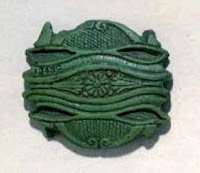 |
Eye of Horus with snakes cited in Mabry.
|
From Andrews 1994, pl. 46.
He also
considers the Eye of Horus to be an A. muscaria because ... wait for it ... that
amulet looks like a snake head and the red crown combined ... if you are very
selective about your image, and hold it upside down ... because snakes are symbols of mushrooms and their venom supplies a buzz.
Adding that this
amulet was fed to Osiris by his son Horus in order to rejuvenate him after
death. Wait, but I thought Osiris was the mushroom... (p. 29, citing Budge 1911,
p. 89).
The god
Horus feeding Osiris his own eye neatly rounds off another rationalisation that
is made by woosters and mushroom fans that the A. muscaria was the
legendary Food of the Gods or Flesh of the Gods. Therefore, because of this it
is also rationalised that Osiris bestowed mushrooms on humankind (facepalm ... he taught humans agriculture, food was his gift), and that the sacred mushroom was forbidden to the rest of
the populace and exclusive to Egyptian royalty (p. 28).
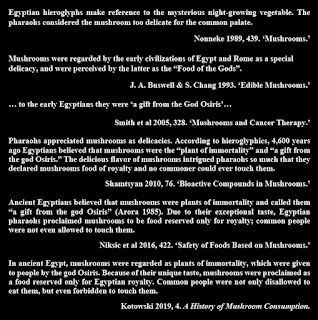 |
| Telephone
game bullshit that should not occur. None of this is correct. |
The myth may be sourced to articles in a US food industry journal in the 70s.
Stop it now.
This sort of
dubious analogy is core stuff for this topic, cannibalistic eating of the Flesh
of Gods combined with secret rituals involving kings consuming magic mushrooms.
So before moving on, let’s just be clear - the ancient Egyptians had no religious
tradition of eating their gods or ritual cannibalism... this is out of date
bullshit... even Budge struggled with it in 1904.
‘Finally it
is said that Unas eats men and feeds upon the gods. We have already
referred to
the passage in Juvenal’s Fifteenth Satire in which he declares that
the Egyptians
ate human flesh.’
‘the
fact remains that there is not a particle of evidence in the Egyptian
inscriptions.’
Budge 1904,
pp. 28 & 36.
They were also not into
secret messages involving magazine fold-ins. It is really not that easy to fold
up a solid wooden shrine with plaster facings ...
 |
Mabry citing Puharich for mushroom symbols.
|
Original image from Puharich (p. 158) arguing this shows 4 sacred mushrooms.
Mabry’s
inspiration for his ideas, apart from Mad Magazine, was a book by Martin
Larson (1977) that claimed the Christian Eucharist was derived from an ancient
Egyptian practice of cannibalism, this argument itself derived from the old
meta-narratives that toy with this idea. Also, he dabbles in Robert Graves
(White Goddess) and selected Pyramid Texts as translated by Budge.
Overall
much credit must be laid with the book by Andrija Puharich which
supplied most of the ground theory for this paper. But before going there,
brief mention must be made of a whacky little book that came out in the same
year as Mabry’s paper.
3. Mushrooms and Mankind: The Impact of Mushrooms on Human Consciousness and
Religion (2000)
James Arthur is a complete blank, as there is no biography available anywhere to flesh out who he is, or was. What I do know is he published this monstrosity with the US based fringe publisher The Book Tree, if you want to read up to date tosh about nephilim giants or aliens building the first civilisations using modified DNA this is the perfect publisher for you.
Arthur’s
book is therefore an indulgent exercise in smoodging fringe theory from various
sources and making it all about secret shamanic rituals involving
the consumption of magic mushrooms in every religious sect from ancient Egypt
to Mesopotamia, then onward to Rome and the cult of Mithras, culminating in the
Freemasons and western governments who are an elite cabal secretly running
the world and imposing fascism on its sheeple.
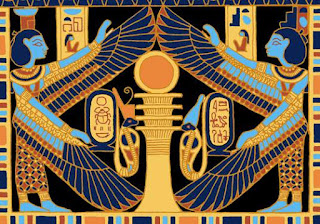 |
How many mushrooms? Pectoral of Tutankhamen. Image A. Sinclair.
|
Arthur - ‘Ankh, djed, disc, snakes and wings’ (p. 55).
For Egypt it
is a wild ride that I can only summarise here – basically, the Egyptian
Underworld god Osiris was the original dying and reborn Santa Claus, as well as
Krishna, Jesus and Mithras, who rode a chariot through the sky, his birthday
being the 25th of December (and that of his son Horus).
At his death a fir tree
grew over his corpse and people put presents around this tree to celebrate... wait...
why? I thought Osiris’ birthday was in August.
Again, like
for Mabry (and Berlant), Arthur claimed the A. muscaria was the Food/Flesh of the
Gods, the plant of life and consumed in secret rituals of transcendance, but he
also added original touches, like these initiatory rites were performed in the ‘multidimensional’
pyramid of Giza with the sarcophagus in the main chamber as decompression
unit... ouch.
The ankh,
djed pillar and Eye of Horus are again included as symbols of these
mushrooms and their secret rituals, but he also includes the was sceptre
(ears look like gills), the Aten disk (round and red), scarab beetle, sacred
cobra, wings on just about anything (gills), and the tops of pillars in ‘all’
Egyptian temples (Polypores, Pleurotus spec, A. muscaria, P.
cubensis).
Also, like
Berlant (2019), he suggested that the word Amanita is eerily similar to the
name of the god Amen (more correctly Imen) and the underworld Amenta (Imentet),
coincidence, they think not (p. 46) ...
Ugh, yeh... no... sounds-a-bit-like
is characteristic of fringe ‘linguistics’, and not to be pedantic, but
Amanita describes a big family of variously edible, deadly, and inedible fungi, not just the
cool red one.
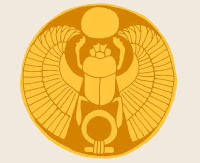 |
| Scarab from the tomb of Tutankhamen. |
Highlights
of Arthur’s claims would be the inference that the Eye of Horus, called by him
a ‘djed-eye’, is somehow
spookily connected to George Lucas’ Jedi (p. 19), or that young Egyptian women
would use the djed amulet in fertility rituals as a practice phallus... seriously,
do not try this at home (p. 53).
His sources
for this book were naturally Budge, Gordon Wasson (Siberian shamanism) and John
Allegro (Jesus was an A. muscaria), but for Mesopotamia he used that good ol’
shonky purveyor of Anunnaki woo, Zecharia Sitchin, and then he added magic
mushrooms ... did you know Enki was a mushroom? ... I certainly didn’t (pp.
35-8).
For ancient
Egypt, Arthur (like everybody else) freely elaborated on ideas that he lifted
directly from the following book by Andrija Puharich…
If you think it was
weird before, it is about to get weirder.
4. The Sacred Mushroom: Key to the Door of Eternity (1959)
This entire
shroomy fiasco began within the 1950s occult scene in New York high society, and in the mind of American
parapsychologist and ESP researcher, Henry (Andrija) Puharich. Therefore many,
if not most, claims raised in the previous publications are derived from his
book.
And it is a fascinating
backstory which began when a sculptor named Harry Stone (his surname was
actually Stump), for reasons probably only clear to himself (opportunity?),
entertained people at a society dinner in New York in June 1954 by handling an
ancient Egyptian pendant that was owned by the hostess
(p. 8).
On doing
this Stone fell into a trance in which he regressed to a past life as an
ancient Egyptian priest called RA HO TEP, whom he sort-of claimed was the
adopted son of the famous Imhotep of the Old Kingdom. I say ‘sort-of’, because
Stone actually just said he was an orphan brought up by a man who made
buildings (p. 15) ... later in the transcripts he claimed to be a king...
Puharich
joined the rest of these and many other dots afterwards, like deciding that the
priest could not be a son of Imhotep, architect of Djoser, and must be prince Rahotep
(of the famous statue), high priest of Heliopolis, and a son of Seneferu. According
to him this Rahotep was later cruelly murdered by Khufu, who wickedly
suppressed the mushroom cult (pp. 121-3, 219) ... yeh, whatever... why is
no-one ever a peasant in these things?
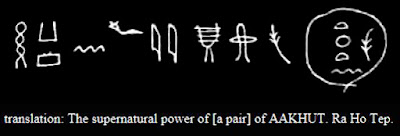 |
This
is bollocks, basically just a stream of poorly drawn signs (p. 47).
|
Past life
regression via hypnosis was all the rage in the mid 1950s due to a magazine
serialisation and popular book by Morey Bernstein called The Search
for Bridey Murphy. I can vouch for its popularity, as my mum, in an
entirely different country and decade, had a copy, I read it as a teen, seemed
legit at the time... but unsurprisingly, turns out it isn’t.
The hostess
of the aforementioned dinner party was a wealthy philanthropist named Alice Muriel Astor Bouverie (yes, those Astors), who just
happened to be a generous sponsor of Puharich and his research foundation, the
Round Table. This foundation was dedicated to ESP research, and they dabbled in the notion of an overarching divine authority called ‘The Nine’, which they believed were the Egyptian Ennead gods .... seriously, you couldn’t
make this stuff up.
Astor had a
reputation for eccentricity, heaps of cash and a soft spot for ancient Egypt. In the 1920s she claimed to be
the reincarnation of an Egyptian princess during the reign of Akhenaten,
according to her 1st husband, a Russian prince. She also claimed to have been
at the opening of Tutankhamen’s tomb and to have secretly acquired a gold
necklace with ram’s heads from this (Obolensky 1958, 271-2)... emphasis on ‘claimed’.
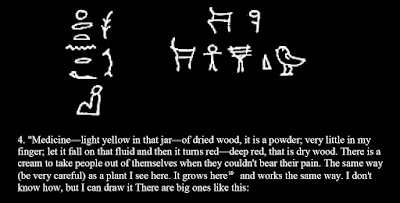 |
I don't think you really need to be an Egyptologist to see this is bollocks (p. 16).
|
Therefore, she was probably very excited to find another ancient Egyptian medium that evening
in New York, and forthwith sent a written copy of Stone’s trance to Puharich, and then
continued recording these on further occasions, presumably after the sherry,
but before the gentlemen retired to the library.
During these
entertaining episodes that were inclusive of automatic writing and speaking in
tongues, Stone claimed that a yellow plant with white spots was used by priests
to make a cream that was rubbed on the crown of the head. The plant could also be placed on the tongue
and was for relieving pain and stimulating psychic abilities.
He also
quite conveniently drew this plant for the audience… Yes, that is correct,
this guy was an artist.
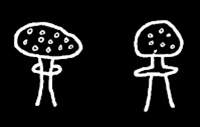 |
Stone's drawing of the golden plant, p. 16.
|
On receiving
the copy of Stone’s trance from Astor, Puharich got quite excited and bustled
off to his research foundation ... where he (like everybody else in woo-town) grabbed the
nearest copies of EAW Budge and somehow translated Harry’s drawings according to
his own expectations, because seriously, the hieros are gibberish, some signs
are complete fiction.
Later in the
summer of 1955 they tramped out into the foundation’s 65 acre estate
looking for mushrooms that supply a buzz, conveniently guided by instructions
from Astor while she was under hypnosis (p. 78), and on finding
some, experimented with rubbing these on their heads and chewing them (pp.
96-7). The results were unsurprisingly variable, with no significant paranormal activity.
Nonetheless, Puharich continued to document more interviews with Stone, until the latter ceased to produce coherent hieroglyphs (say what?), or go into trances... perhaps the novelty wore off. As a solution he experimented with other receptive people cold-handling Stone’s drawings and documented their visions (see celebrity psychic Peter Hurkos), after which he wrote a book about it, the rest is pseudo history.
This book is
the source of the idea that an Egyptian crown was a mushroom. As well,
Puharich is responsible for the idea that the ankh, was sceptre
and Eye of Horus were A. muscaria, that this fungus was the AAKHUT, AAK KHUT or ‘plant
of life’, and the ‘Food/Flesh of the Gods’.
 |
Portal of the Otherworld, a pair of AAKHUT, p. 171.
|
These 3 signs are the name of a Lower Egyptian god called Hephep, or Hepwy,
who is attested from royal jubilee scenes of the Old Kingdom.
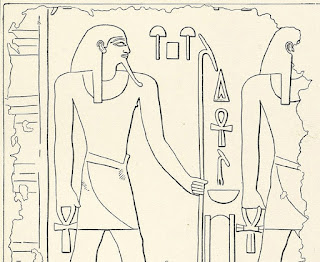 |
HepHep from Jequier 1938, Pepi II, pl. 60.
|
He also
proposed that the hieroglyph for a sunshade was the
symbol of this cult and of the ‘portal to the Otherworld’, and that the solar falcon
perched on the Amentet symbol from the Book of the Dead showed a
mushroom (pp. 147-53). Finally, he also dabbled with the kheper
scarab being symbolic of this ascension rebirth rite (p. 130).
Every
publication claiming magic mushrooms were used in ancient Egypt owes their
argument to Andrija Puharich, and to a much lesser degree to Gordon Wasson (1969) who
wrote the textbook on magic mushroom use in Siberian shamanism (which is not
crap, although some claims are disputed), but credit must also go to John
Allegro (1970) who argued that Jesus was a magic
mushroom (this one however is crap).
 |
From the autobiography of Alice Astor's 1st husband.
|
After the
funds fizzled out on the unexpected death of Alice Astor in 1956 Puharich went
on in his parapsychology career by later collaborating with Uri Geller, you
know - bendy spoony Saturday afternoon talk show guy - however he never went
further with the psychoactive mushroom research.
 |
Biography of Gore Vidal, a close friend of Alice.
|
These
swashbuckling tales of mystics, mushrooms and New York high society all sound
like firm foundations for a legitimate argument about psychoactive mushroom use in
rituals in far antiquity, no? Well, to be honest Wasson was the
highlight, because once this topic hit Egypt it was downhill all the way.
A few brief
explanations of the symbols often used to argue these points on woo sites.
5. Symbols, signs, royal rituals
So here’s the thing with the ancient Egyptians. They were quite good at visual communication. The following images are examples of this and of the importance of understanding context, because your average fringe dweller only looks at the images and ignores the other quite useful information.
These scenes
are not isolated snapshots that are free to interpret, because Egyptian
hieroglyphs were translated nearly 200 years ago. And if someone is prepared to
accept the translation of the name Cleopatra, or Tutankhamen, or Budge’s clunky
and antiquated translations of the Pyramid Texts then they probably have to
accept translation works at a basic level, or they need to start over from
scratch and prove academics wrong...
Anyway, my
point is that these images come with captions... or like the next image, they
are text.
 |
Forti at Trinfinity blog.
|
Signs for sunshades
The relief
shown above from Trinfinity is often used to argue that the sunshade and
its hieroglyph are symbols of the secret mushroom ascension ritual. This is because
the uninformed viewer is choosing to see 2 similar ‘mushroom-like’ signs.
Puharich
called this sign a sunshade or fan, which is correct, as it represents a
feather fan. The name gives this away, because the word shut (šw.t) is
most likely derived from shut ‘feather’. Some of the problem here
may be attributed to interpreting the English word ‘sunshade’ as a parasol, or
umbrella, when a large fan can give shade too.
I might also
add that elsewhere on the woo-net this same sign is claimed to be a UFO landing
on a pyramid (see my critique of that here).
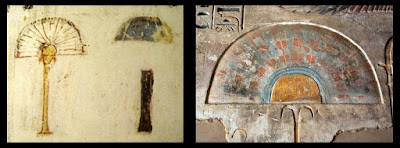 |
Left, hieros tomb of Rekhmire. Right, a royal fan from Medinat Habu.
|
Image (L) Boulanger 1965 (R) Bruce Allardice at Flickr.
Nonetheless, the image
from Trinfinity does not show mushrooms, it is 3 signs making one word – ‘fan’
or ‘shadow’ (one of the human souls) that was written with the fan sign and
the letter ‘t’. The vertical stroke under the ‘t’ has no sound value, it
indicates you are looking at a sign group – a word. In Trinfinity's photo these
signs are clearly painted different colours.
- A feather
fan is not a mushroom.
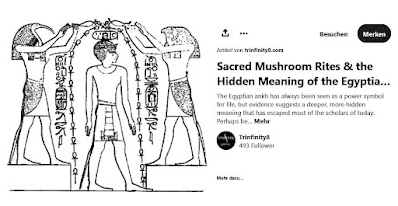 |
Trinfinity again. Image from Pinterest.
|
The water of life ritual
This ritual
is fairly common from royal monuments after around 2000 BCE. Because of this it
is relatively clear to Egyptologists what it involved – it was a symbolic
purification libation poured over the king by the gods responsible for granting kingship, usually Horus and Set/Thoth. A variant on this symbolism
later also gets adopted by (cashed up) normal people in New Kingdom funerary
symbolism.
Pseudos
interpret this image as a shamanistic ritual involving magic mushrooms or
mushroom liquid, because Puharich, and later Arthur, argued that the ankh
is a symbol for A. muscaria – the idea being that the
loop is the cap and the crossbars the frill.
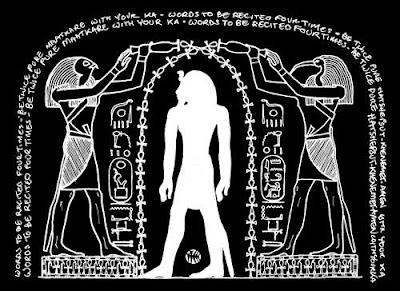 |
Hatshepsut being anointed by the gods, Karnak. Image A. Sinclair.
|
The ankh
was the symbol of life and of regeneration, so at a basic level the
image of a king having these poured over him is easy to interpret – the king is
granted eternal life. However, the material that was poured over the king
is not difficult to fathom, because sometimes they did not use ankhs in
these scenes, they used a blue zigzag line, the Egyptian sign for water.
- Water was
a symbol of life.
Which makes
perfect sense from a culture who were dependent on the annual flooding of the
Nile river for their existence.
 |
Trinfinity blog.
|
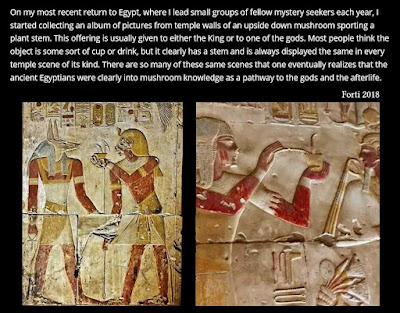
Senetjer offered to a god or king
Again, nothing like being ignorant of ancient symbolism and then
claiming on the internet that you have discovered a secret that nobody else on
the planet has noticed. This is btw original, as none of the authors cited
above have suggested this... 1 point for originality... Forti claims
that this scene shows an upside-down mushroom being fed to a god or king.
Nonetheless,
the Egyptian caption says otherwise, as this type of ritual scene has a text directly
below the object in the king or officiant’s hands stating exactly what this is,
and what is going on, often there is also a longer description above the scene
as well. These captions read – ‘making or producing senetjer for – god
or dead king’s name’.
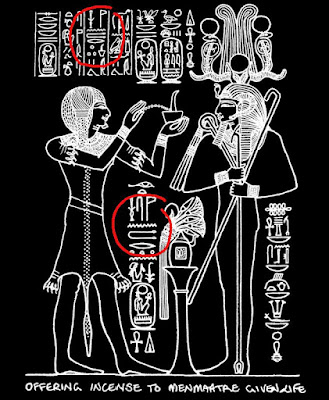 |
Abydos temple of Seti I. Image A. Sinclair.
|
Now we know
that the text and image go together because the sign that identifies the word senetjer
is the same symbol as the one that is offered (see cup in top text).
In
addition, the word group has 3 signs that look like small balls, which
also hints at
what it was – little lumps of aromatic resin – like frankincense and
myrrh. If you look close you can see the iwnmutef priest is actually throwing little balls into the cup.
 |
| The hieroglyph for incense. Sinclair. |
Therefore, senetjer
is incense – burning in a cup. The Egyptians burned lumps of incense in small cups with
straight sides and thick bases, or on long censors with a hand holding a cup on
the end.
These images show the cup with flames rising from the burning
resin, which incidentally always points towards the god or dead king who is
breathing the sacred smoke.
Also A. muscaria does not have a red stem, but
surprisingly fire can be a bit orange-red.
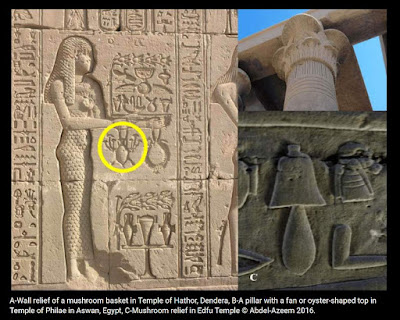 |
| A. Vase with lotus leaves. B. Temple capital. C. Hieroglyph for chisel. |
Temple columns
This little
theory is again the result of seeing mushrooms where there are none.
But this time
the source is pseudoscientist James Arthur (2000) who on visiting Egypt noticed the capitals of temple
columns had elaborate plant forms. They do btw... but I am going to
emphasise the words ‘plant forms’. This is a long-standing Egyptian
tradition and these designs became quite elaborate in the 1st millenium.
Before this
the capitals of columns were often decorated with less ornate tops. However, in
all periods these decorations were mostly the symbols of a unified Upper and
Lower Egypt, the south flower, blue and white lotus, papyrus, or even the heads
of the goddess Hathor. None were based on edible or psychoactive fungi
varieties, this is subjective thinking.
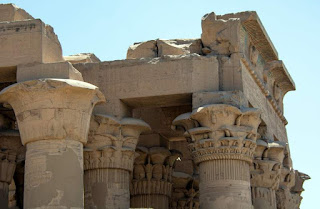 |
Papyrus capitals from the temple of Horus and Sobek, at Kom Ombo.
|
Image by Bruce Allardice at Flickr.
- Mushrooms
are not plants, and
incidentally -
- Any and all
mushrooms are not evidence for magic mushrooms.
6. Misinformation in media
The text
below brings me back to an earlier observation about the unfortunate influence
of these publications on media and academia beyond Egyptology, as this quote is not
sourced from a pseudoscience website, but rather from the website and papers of
a mycologist who has adopted the claims of Arthur and Berlant as though they
were legitimate scholarship, presumably with the intention of giving his
contemporary research into food production an interesting backstory.
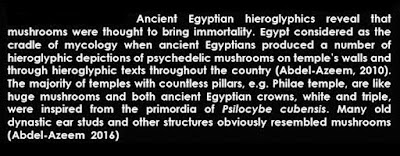 |
Abdel Azeem et al 2016.
|
He is not
alone and a few other academics in mycology, food industry journals and psychoactive research have also made this error, by repeating the various modern falsehoods about mushrooms in ancient Egypt, particularly the myths of the Food of the Gods,
the plant of immortality, gift of Osiris and that consumption of these fungi was the
exclusive right of royalty.
This
oversight illustrates the problems associated with sourcing out of date literature when
researching a paper, combined with decades long down-the-line citation
(telephone game academia), and the pitfalls of combining very specialised
knowledge with not consulting experts in other disciplines, because these
authors are citing earlier authors in their own fields and not consulting
Egyptologists.
Conclusion
I’ll put it
as concisely as possible, if you consult an Egyptologist who dabbles in
pharmacology they will tell you:
- There is no evidence from pharaonic Egypt for a cultural value for any kind of fungus, except yeast – because bread, wine and beer were really important.
- There is no word in their writing system for a fungus, except possibly yeast, ergot and mould.
- There is no mushroom hieroglyph. The proposals are all misidentifications of existing signs
 |
| These are hieros for cool things, but they are not mushrooms. Image A. Sinclair. |
- Nor are there any confirmed images of mushrooms – the misidentifications include lotus leaves and flowers, papyrus, and sundry cult symbols.
- There have been no findings of archaeological residues of any mushroom from Egyptian burials or food preparation areas... nada.
- Neither P. cubensis nor A. muscaria are known from Egypt, so the choice of these by pseudos is an example of ethnocentrism - ‘our drugs must be their drugs’. A. muscaria is a cool climate mushroom that grows in oak and fir forests, the yellow variety (var. guessowii) is specific to North America. P. cubensis is a tropical fungus that grows in dung in warm wet climates, it is the most well-known psychoactive mushroom outside of European folklore about A. muscaria (see Guzman et al 1998). If the Egyptians did have a local psychoactive mushroom it is unlikely to be these.
A few points to consider:
Symbolism -
The symbolism of ancient Egypt was not photographic, they showed the important information, which means they depicted
objects from various angles in one image. Therefore, it is quite
important to know their symbolic vocabulary before jumping to conclusions from
a blurry photo on the internet. Being able to read their texts does not hurt
either. The images used by pseudos to support their arguments illustrate their
lack of insight, they are subjective, ignore the study of hieroglyphs, they
ignore colour (unless it suits their argument, oh look, it’s red).
Values - The
Egyptians lived in another time, they therefore placed magical value
on things in their environment that we might consider mundane, if we
ignore this we are in danger of imposing our values on them, like believing
that a bunch of onions or bread or water must be a magic mushroom, rather than something of local
significance. However, the Egyptians did value certain psychoactive
substances, we know they did, like alcohol, lettuce, the lotuses, mandrake, these had
spiritual, medicinal and recreational value.
Sources -
These are not always made clear, particularly when an author is trying
to give their claims a veneer of credibility, like Berlant, who is careful to
avoid citing Puharich, yet who is indebted to The Sacred Mushroom
through Mabry. I would say the same for the academic
publications that cite mycology and ethnopharmacological texts going back 50
years. Like the myth of mushrooms being exclusive to kings or
the Food of the Gods in ancient Egypt, but now this nonsense is on every perky
website devoted to edible mushrooms on the planet.
To describe
this as sloppy is overwhelmingly inadequate.
In addition,
these authors cherry pick information from scholarship that is
ludicrously out of date... pls stop citing Budge... Equally, citation of Roman botanical texts is nice, but apart from the flights of fantasy these sometimes involve, this tells us nothing about the pharaonic period. Naturally because of the use of older literature these works are biased towards the thinking of earlier periods and on the
inclination to create universal narratives,
plus the translations in them are obsolete.
 |
| Crazy About Mushrooms blog 2015, a dizzying mix of complete fiction. |
Citation please.
Close
As you may have noticed the claims about magic mushrooms in ancient Egypt are a veritable trip down the burrow of that anxious white rabbit from Alice’s Adventures with obligatory hookah pipe, giant mushroom, add a judicious dash of paranoia, then a teaspoon of past life regression and a pinch of automatic writing for lols. To be honest the amount of artistic licence in this myth is actually mind boggling.
To summarize, the claims of the writers cited here are a dog's breakfast of brain farts and confirmation bias loosely connected together by carefully cherry-picked ancient texts and misunderstood images. But I honestly must thank them, because in going down this rabbit hole I discovered a plot worthy of Agatha Christie, containing gullible heiresses, foreign princes, seances, mystics, Egyptian amulets, even down to rumours about foul play on the sudden death of Alice Astor in 1956... it was a wild ride.
That being said, while entertaining at many levels, this narrative does not provide any evidence that the pharaonic Egyptians knew mushrooms, ate them, or even valued them in any spiritual way.
It is all poorly argued speculation.
Andrea Sinclair
2022
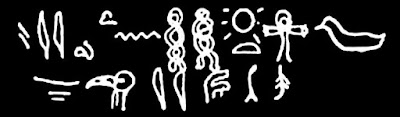 |
Drawing by Harry Stone, don’t laugh, they were serious, Puharich p. 111.
|
Further reading and sources
Allen, JP. and P. der
Manuelian 2005. The Ancient Egyptian Pyramid Texts. Society of Biblical
Literature.
Andrews, C. 1994. Amulets of Ancient Egypt. British Museum Press.
Boulanger, R. 1965. Egyptian and Near Eastern Painting. Heron.
Huxley, A. 1977. Moksha:
Aldous Huxley's Classic Writings on Psychedelics and the Visionary
Experience (1931-1963). M. Horrowitz and C. Palmer eds. Stonehill, (pp.
72-3).
Jacobsen, A. 2017. Phenomena:
The Secret History of the U.S. Government's Investigations into Extrasensory
Perception. Back Bay Books.
Kaplan, F. 2000. Gore
Vidal: A Biography. Bloomsbury.
Obolensky, S. 1958. One Man
in His Time. McDowell.
Poller J. 2019. Aldous Huxley and Alternative Spirituality. Brill.
Samorini, G. 2019. ‘The Oldest
Archaeological Data Evidencing the Relationship of Homo Sapiens with
Psychoactive Plants: A Worldwide Overview’. Journal of Psychedelic Studies
3(2): 63–8.
Sinclair, A. 2024, ‘High Times in Ancient Egypt.’ In Alternative Egyptology: Critical Essays on the Relation Between Academic and Alternative Interpretations of Ancient Egypt, B.J.L. van den Bercken (ed.). Sidestone.
Wasson, RG. 1968. Soma: Divine Mushroom of Immortality. Harcourt.
Wise, E. 2009. ‘An “Odor of
Sanctity”: The Iconography, Magic and Ritual of Egyptian Incense’. Studia
Antiqua 7(1): 67–80.
Don’t do it, it’s a trick (out
of date)
Budge, EAW. 1895. The
Book of the Dead: The Papyrus of Ani in the British Museum. Oxford
University Press.
Budge, EAW. 1904. The Gods of the Egyptians: Or Studies in Egyptian Mythology.
Methuen.
Budge, EAW. 1911. Osiris and the Egyptian Resurrection. Putnam’s Sons.
Larson, MA. 1977. The Story of Christian Origins or: the Sources and Establishment of
Western Religion. New Republic Books.
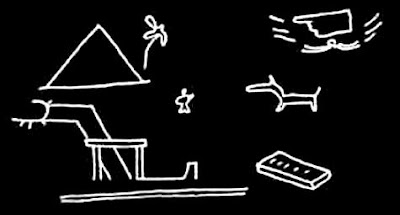 |
Drawing by Peter Hurkos after handling Stone's drawing above, Puh. p. 112.
|
Mycology
Arora, D. 1986. Mushrooms
Demystified: A Comprehensive Guide to the Fleshy Fungi. Ten Speed Press…. Fyi, Arora never said mushrooms were the gift
of Osiris.
Guzman, G., J.W. Allen, and J.
Gartz, 1998. ‘A Worldwide Geographical Distribution of the Neurotropic Fungi,
an Analysis and Discussion’. Annali del Museo Civico di Rovereto 14:
189–280.
Jay, M. 2020. ‘Fungi,
Folklore, and Fairyland’. The Public
Domain Review.
https://publicdomainreview.org/essay/fungi-folklore-and-fairyland
Laessoe, T.
and JH. Petersen 2019. Fungi of Temperate Europe. Princeton University
Press.
Stamets, P.
1999. Psilocybinpilze der Welt: Ein praktischer Führer zur sicheren
Bestimmung. AT Verlag.
Academic citations of the
myths (sample)
Abdel-Azeem, AM. 2010. ‘The
History, Fungal Biodiversity, Conservation, and Future Perspectives for
Mycology in Egypt.’ IMA Fungus 1(2): 123–42.
Abdel-Azeem, AM. et al. 2016. Conservation of Mushroom in Ancient Egypt through the Present. Poster presented at the ASFC conference, Ismailia, Egypt, Oct. 18-20, 2016.
Kotowski, MA. 2019. ‘History of Mushroom Consumption and its Impact on Traditional View on
Mycobiota – An Example from Poland’. Microbial Biosystems Journal 4(3) (p. 4).
Mattos-Shipley et al. 2016. ‘The Good, The Bad and the Tasty: The Many Roles of Mushrooms’. Studies in Mycology 85, (p. 130).
McHugh, AM. 2015. ‘Mushrooms
in History: Ancient Greece and Egypt’. Crazyaboutmushrooms.com. https://www.crazyaboutmushrooms.com/2015/05/27/mushrooms-history-greeks-egyptians/
Niksic, M., A. Klaus, and D. Agyropoulos 2016. ‘Safety
of Foods Based on Mushrooms’. In Regulating Safety of Traditional and Ethnic
Foods, V. Prakash, O. Martin-Belloso, L. Keener, S.B. Astley, S. Braun, H.
McMahon, H. Lelieveld (eds). Academic Press, (p. 422).
Nonneke, IBL. 1989. ‘Mushrooms’ in Vegetable Production, (p. 439).
Sackett, C. 1975. ‘Mushrooms’. Fruit and Vegetable Facts and Pointers. United Fruit and Vegetable
Association, Washington DC.
Shamtsyan, M. 2010. ‘Bioactive Compounds in Mushrooms’.
In Encyclopedia of Biotechnology in Agriculture and Food 1(1): (p. 76).
Smith, JE., R. Sullivan, and N. Rowan, 2005.
‘Mushrooms and Cancer Therapy’. Biologist 52(6), (p. 328).
Winkelman,
M. 2019. ‘Evidence of Entheogen Use in Prehistory and World Religions’.
Journal of Psychedelic Studies 3(2): 43–62.
 |
I just like A. muscaria. Taken in late autumn A. Sinclair
|
Pseudo sources
Allegro, JM. 1970. The Sacred Mushroom and
the Cross. Sphere Books.
Arthur, J. 2000. Mushrooms and Mankind: The
Impact of Mushrooms on Human Consciousness. California: The Book Tree.
Berlant, SR. 1999. ‘The Prehistoric Practice
of Personifying Mushrooms.’ Journal of Prehistoric Religion 13: 22-30.
Berlant, SR. 2005. ‘Entheomycological Origins
of the Egyptian Royal Crowns and the Esoteric Underpinings of Egyptian
Religion.’ Journal of Ethnopharmacology 102: 275-88.
Berlant, SR. 2019. ‘Introduction to the
Mycolatrical Origin of Egyptian Religion: Why Identifying the many
Mushroom-like Objects in Egyptian Art as Mushrooms can Explain those Objects
and Ancient Egyptian Religion far better than Egyptologists have. Draft –
Academia.edu/Researchgate.
Berlant, SR. 2019. ‘An Egyptian Christmas Tree
in the Tomb of Roy. Draft – Academia.edu & Researchgate.
Bernstein, M. 1956. The Search for Bridey
Murphy. Doubleday. (First
published in 1954 in the Denver Post).
Forti KJ. 2018. ‘Sacred Mushroom Rites and the
Hidden Meaning of the Egyptian Ankh.’ Trinfinity blog.
https://trinfinity8.com/tag/amanita-muscaria/
Geerken, H. 2000. ‘Paramykologie.’ In Der
Fliegenpilz: Traumkult, Märchenzauber, Mythenrausch, W. Bauer (ed), 23-30.
AT Verlag.
Lloyd, E. 2016. ‘Mysterious Ancient Mushrooms in
Myths and Legends: Sacred, Feared and Worshiped among Ancient Civilizations.’ Ancient
Pages.
https://www.ancientpages.com/2016/09/14/mysterious-ancient-mushrooms-in-myths-and-legends-sacred-feared-and-worshiped-among-ancient-civilizations-2/
Mabry, M. 2000. ‘Osiris: Eine Reidentifikation.’
In Der Fliegenpilz: Traumkult, Märchenzauber, Mythenrausch, W. Bauer
(ed), 23-30. AT Verlag, 23-30.
Puharich, A. 1959. The Sacred Mushroom: Key
to the Door of Eternity. Doubleday.


.jpg)


